Quantum discussions at the White House and U.S. Department of Energy
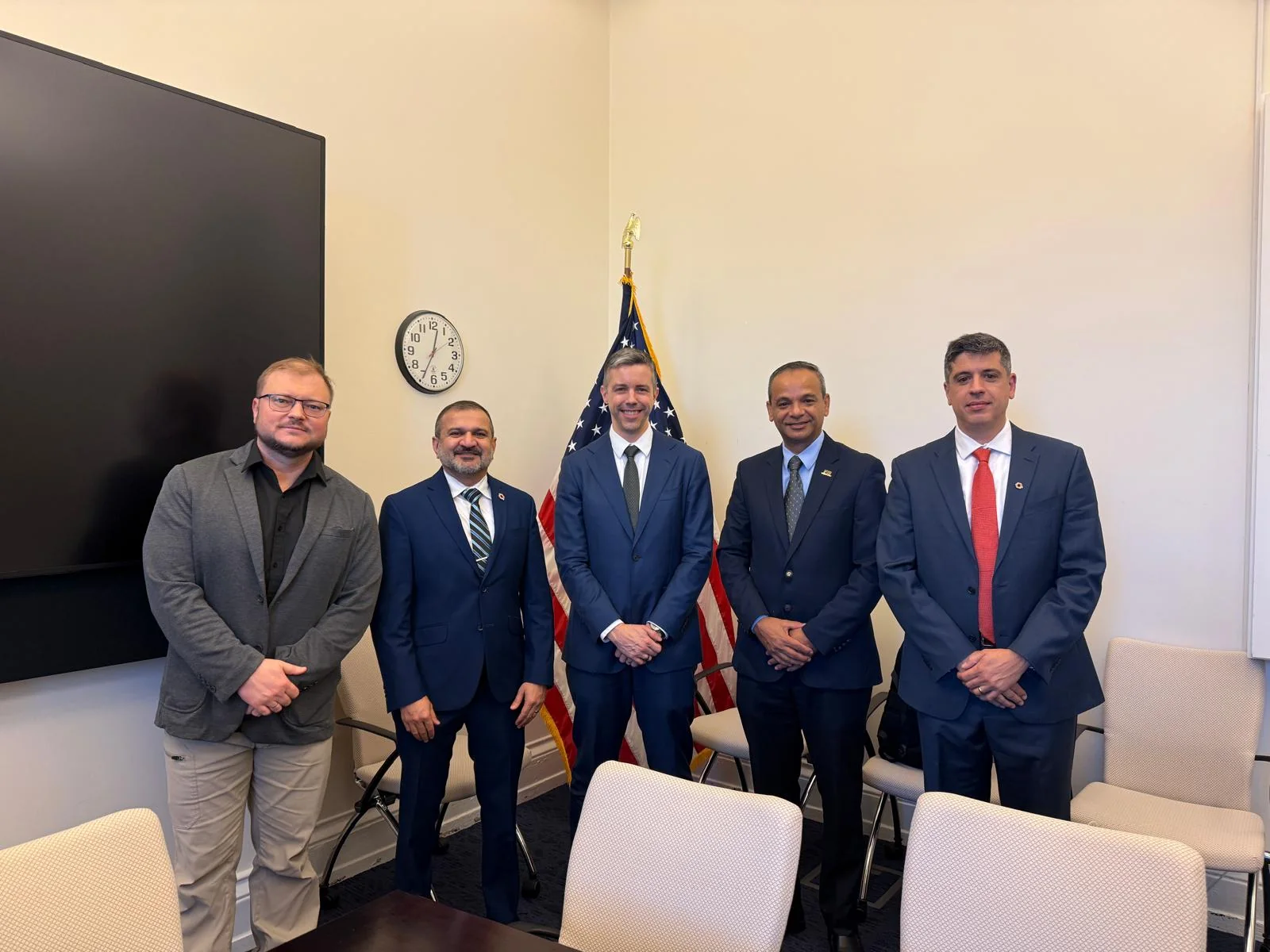
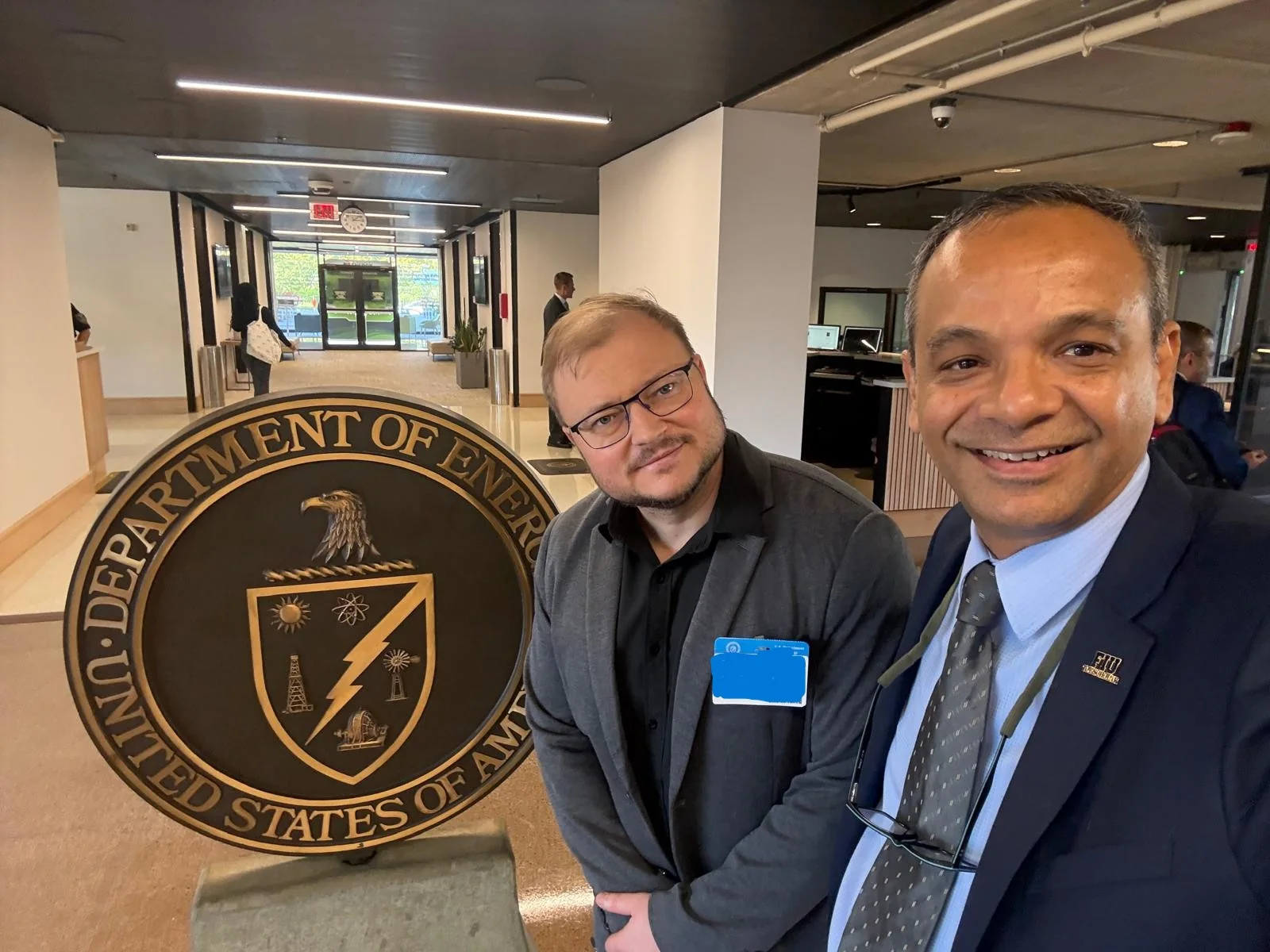
Prof. Aleksandr Krasnok visited Washington, D.C., for meetings at the White House and the U.S. Department of Energy on strategic priorities for advancing quantum computing, science, and technology in Florida.
Prof. Krasnok thanks Dr. Brad Blakestad, Director of the National Quantum Coordination Office (NQCO), for the warm welcome and thoughtful discussion. The visit brought FIU’s growing quantum research and education efforts into conversations with federal leaders.
Meetings in Washington, D.C., on quantum science and technology in Florida.At the U.S. Department of Energy.
Invited talk
Quantum computing through the lens of physics
Prof. Krasnok presented “Quantum Computing through the Lens of Physics” at Missouri State University’s Physics, Astronomy and Materials Science seminar. The talk connected quantum-computing concepts to their physical foundations.
FIU signed an agreement to acquire an IonQ Superion 256 trapped-ion quantum computer, expected to arrive on campus in late 2027. The system will expand direct access to quantum hardware for research and education in Florida.
As a co-founder of the FIU Quantum Initiative and a member of the university-wide Committee on FIU Initiatives in Quantum Science, Education, and Industry Partnerships, Prof. Krasnok contributes to research and educational planning for the program.
The Academy of Science, Engineering and Medicine of Florida selected Prof. Krasnok as a 2026 Rising Star in Engineering. Recognition is scheduled for the academy’s annual meeting in November 2026.
Putting student learning at the center of quantum investments
In Physics World, Prof. Krasnok argues that universities should evaluate quantum-computing investments through what students learn and can do with the hardware. The article discusses how equipment access can serve clear educational goals, alongside research ambitions.
Prof. Krasnok was selected for the Fulbright Specialist Roster for a three-year term, August 14, 2026–August 14, 2029. Roster membership makes him eligible to be matched with short-term projects at institutions abroad, supporting international academic collaboration.
Selective loading of superconducting qubit circuits
“Reflection-Zero Waveforms for Selective Loading in Shared-Line Superconducting Qubit Circuits,” by Deepanshu Trivedi, Aditya Bhowmik, Laraib Niaz, and Aleksandr Krasnok, was published in Advanced Quantum Technologies. The work designs microwave pulses that load a chosen circuit mode while reducing reflection and unwanted excitation of neighboring qubits.
“Complex-Frequency Chirped Pulses for Trajectory-Resolved Scattering,” with Denis Seletskiy in ACS Photonics, introduces shaped pulses that probe a scattering response along a path in the complex-frequency plane.
A companion direction in Physical Review Letters, “Constant-Amplitude 2π Phase Modulation from Topological Pole–Zero Winding,” derives a design rule for a full phase rotation at a fixed scattering amplitude.
Quantum magnetometry for infrastructure; an alumnus joins Nokia
Muhammad Mahmudul Hasan, Ingrid Torres, and Aleksandr Krasnok review quantum magnetometers for infrastructure inspection and monitoring in Measurement. The article examines how atomic and diamond sensors could detect corrosion, stress, and electrical faults, with attention to the practical demands of field measurements.
Former QTM Lab postdoctoral researcher Muhammad Mahmudul Hasan joined Nokia in August 2026.
Open quantum-computing lectures and a forthcoming textbook
The Quantum Computing Lectures repository makes lecture notes, assignments, figures, and Qiskit notebooks available for teaching and independent study. The materials connect quantum models and circuits with practical programming exercises.
Prof. Krasnok’s Introduction to Quantum Computing and Sensing for Electrical Engineers: A Hands-On Guide is forthcoming from Springer. The publisher lists the hardcover for October 28, 2026.
Choosing quantum hardware for university research and teaching
“Universities Need Transparent Quantum Hardware,” in Nature Reviews Physics, and “What Quantum Computer to Buy?,” in AVS Quantum Science, examine the decisions universities face when investing in quantum systems. The articles connect platform choice with access, staffing, facilities, operating costs, and educational needs.
AFOSR support for complex-frequency plasma research
The Air Force Office of Scientific Research awarded $50,000 for “Complex Frequency Excitations in Natural and Artificial Plasma,” with Prof. Krasnok as principal investigator. The project runs from June through November 2026 and extends the lab’s work on shaped electromagnetic excitations to plasma systems.
DOE/Brookhaven collaboration on electro-photonic processing
QTM Lab joined the El-Pho project, an electro-photonics integrated platform for near-sensor processing in extreme environments. Prof. Krasnok is the FIU subcontract principal investigator; the subcontract has a $600,000 ceiling, with $60,000 initially allotted and annual options through September 2029.
NVIDIA also awarded 32,000 A100 GPU-hours for the lab’s CFQ-Control project during January–June 2026, supporting computational research in quantum control.
Prof. Krasnok was recognized as a finalist for the FIU Presidential Excellence Award. He also joined the 2026 cohort of the FIU Science & Fiction Lab Interdisciplinary Faculty Fellowship Institute.
Deepanshu Trivedi completed his Ph.D. in Electrical and Computer Engineering at FIU, co-supervised by Prof. Krasnok. He went on to join imec USA Florida as a Design Engineer on its Superconducting Electronics team, continuing his work on quantum hardware.
Work by Deepanshu Trivedi, Laraib Niaz, Aleksandr Krasnok, and Andrea Alù in ACS Photonics uses complex-frequency driving to excite a selected resonator while suppressing crosstalk. FIU’s College of Engineering and Computing highlighted the study in a feature on the university’s quantum research.
On December 2, Prof. Krasnok discussed the connection between waveform design and selective qubit control in an invited seminar at the University of North Texas.
Three days of quantum computing at FIU Qiskit Fall Fest
FIU hosted quantum-computing workshops, coding challenges, mentoring, and invited talks as an IBM Quantum sponsored Fall Fest host. Prof. Krasnok helped organize and host the event, bringing students together with researchers and industry speakers for hands-on work with quantum circuits and Qiskit.
Prof. Krasnok organized FIU’s participation in Quantum Beach 2025 in West Palm Beach. The event connected Florida universities, industry, and state leaders around quantum research, education, and entrepreneurship.
During 2025, Prof. Krasnok and Prof. Janki Bhimani co-founded the FIU Quantum Initiative to connect research, teaching, workforce development, and partnerships across the university.
Quantum education and sensing at the Florida Quantum Summit
At the University of Florida, Prof. Krasnok presented a Power Talk on FIU’s quantum education and sensing research. The summit brought together university, industry, and government participants to discuss Florida’s quantum research and workforce priorities.
A review by Seunghwi Kim, Aleksandr Krasnok, and Andrea Alù in Science brings together theory and experiments on complex-frequency excitations in photonics and wave physics. It explains how shaping a wave in time can emulate gain or loss and control scattering, energy capture, and propagation without changing the material itself.
FIU Top Scholar in Research and Creative Activities
FIU named Prof. Krasnok a 2024–2025 Top Scholar in Research and Creative Activities, recognizing external awards and honors. He was among seven College of Engineering and Computing faculty members honored that year.
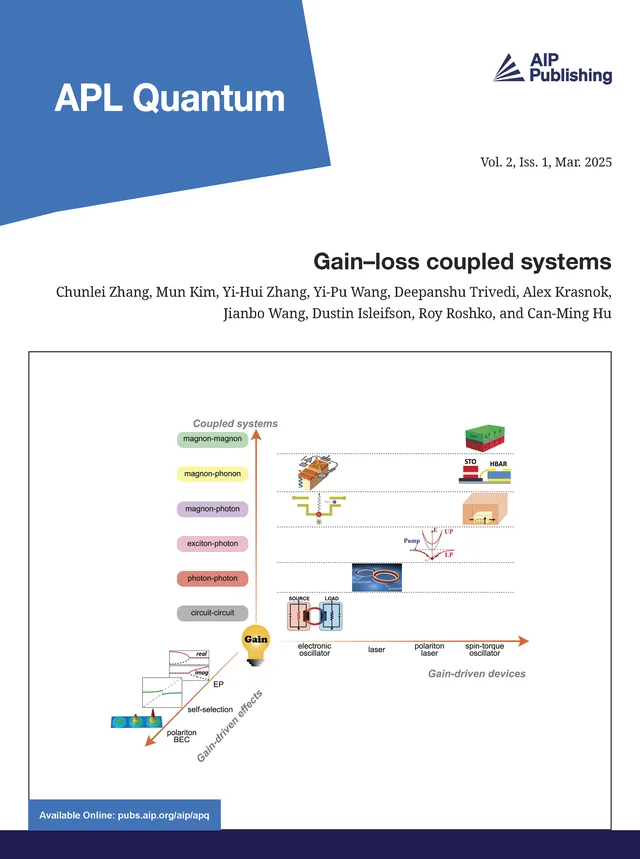
Gain–loss coupled systems on the cover of APL Quantum
The review “Gain–Loss Coupled Systems” examines how amplification, dissipation, and coupling shape classical and quantum devices. The article was featured on the front cover of APL Quantum.
A $50,000 NSF I-Corps award supports investigation of the commercial potential of electromagnetic wave manipulation for MRI. Prof. Krasnok leads the FIU project, which explores how adaptable electromagnetic structures could improve imaging performance.
Superconducting cavities and qubits for quantum information
A review in Applied Physics Reviews examines superconducting microwave cavities, Josephson-junction qubits, and bosonic encodings. It connects material and device choices with the loss and noise mechanisms that limit quantum coherence.
A paper in Applied Physics Letters introduces a Fano-type qubit response for improving isolation and bandwidth in quantum circuits. The study uses realistic circuit parameters and quantum simulations and was featured in the journal’s 2023 Rising Stars Collection.
Prof. Krasnok taught Advanced Quantum Computers in spring 2023 and Introduction to Quantum Computers in fall 2023. The courses connect quantum principles and algorithms with the physical operation of quantum hardware, forming the graduate and undergraduate tracks of his quantum-computing teaching at FIU.
A Physical Review Letters study shows how complex-frequency excitations can produce scattering responses beyond bounds associated with conventional steady illumination. The work explores control of nanoscale light through the time dependence of the incident field.
Single-resonator sensing on the cover of ACS Photonics
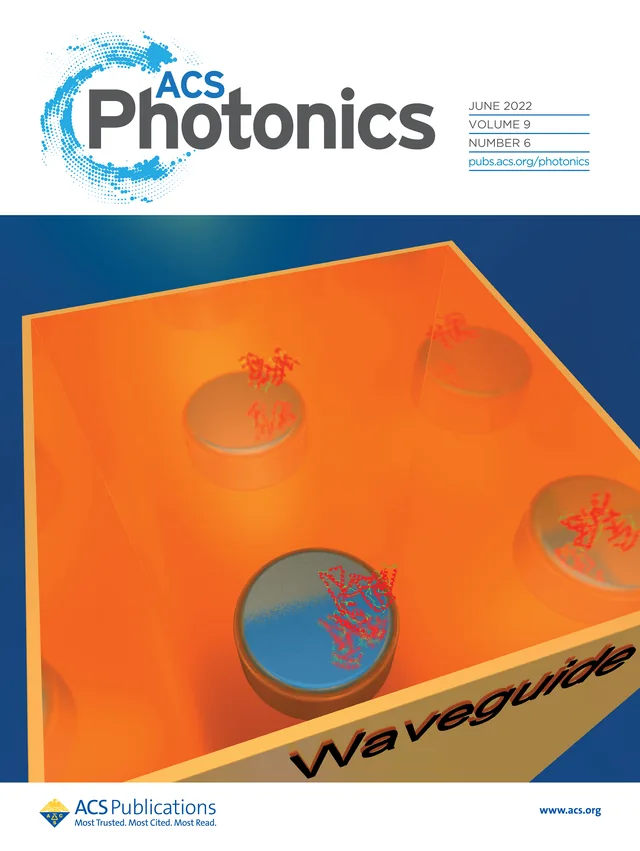
Work with collaborators at DTU and CUNY demonstrates a bound state in the continuum localized in a single resonator by controlling its surrounding boundaries. The experiments use this response to track small changes in water samples. The paper appeared on the front cover of the June issue of ACS Photonics.
Prof. Krasnok joined FIU’s Department of Electrical and Computer Engineering as an Assistant Professor. He established a research program spanning metamaterials, quantum photonics, electromagnetic wave control, and quantum-hardware interfaces, with opportunities for graduate and undergraduate researchers.